|
|
|
Free Trial Download >
nService Free Trial Download and Installation Instructions
|
|
|
| 1. |
Deploy nService4 Files
Download nService4.zip (1M).
Unzip it to Inetpub\wwwroot\. It creates
the Inetpub\wwwroot\nService4 folder.
Also
download
and install Microsoft Report Viewer.
|
| 2. |
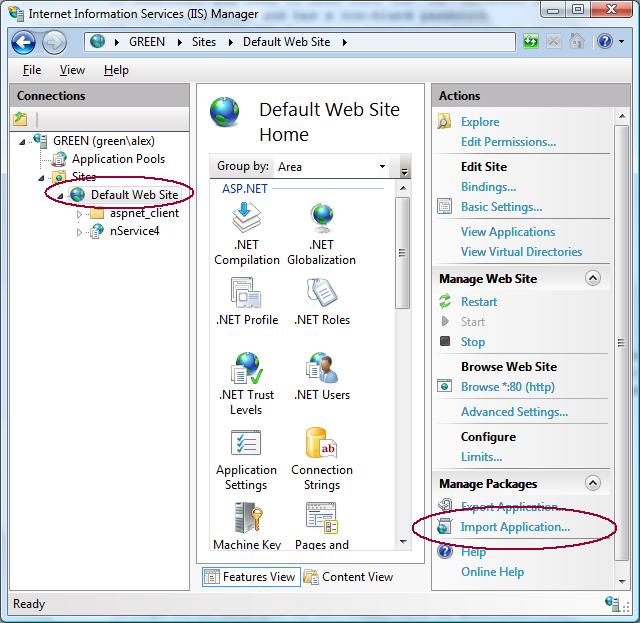
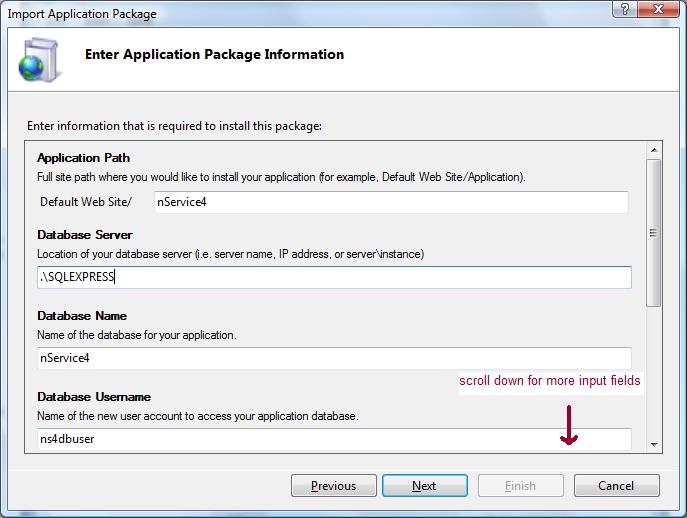
Create IIS Application
(screen shots)
Run Administrative Tools, Internet Information Service (IIS Manager),
right click Application Pools and select New to create a new application
pool called nService4AppPool.
Go back to IIS Manager,
right click Default Web Site, nService4, click Properties and then click the
Create button to create an application. Set it to run in the nService4AppPool application pool.
Go to the ASP.Net tab,
select 2.0x in the version drop down list. If you don't see it, you
need to
download and install .Net 2.0, then relaunch IIS Manager to select it.
Go back to IIS Manager,
click Web Service Extensions, select ASP.Net 2.0xxx on the right pane
and then click the Allow button to enable it if needed.
Go to Administrative Tools, Services, make sure
the ASP.NET State Service is started and the Startup Type is Automatic.
|
| 3. |
Create Database and Tables
(screen shots)
Run SQL Server 2000 Enterprise Manager or SQL Server 2005 Management Studio,
create a new database called nService4.
If you don't have SQL Server,
download
the free Express Edition.
Load Inetpub\wwwroot\nService4\App_Data\ns4ms.sql into SQL Query
Analyzer or SQL Server Management Studio, select the nService4
database and run the script to create tables.
Make sure all ns4_* tables are owned by dbo.
Assign NT AUTHORITY\NETWORK SERVICE datareader
and datawriter role on the nService4 database. If this user doesn't
exist in your database, add a new login from Security/Logins and type in
NT AUTHORITY\NETWORK SERVICE as the login name. Make sure there
is no trailing space after the name. Note this is a
built-in account hence may not show up in a search.
If your SQL Server is on a separate server, substitute all above
NT AUTHORITY\NETWORK SERVICE with
domainName\WebServerMachineName$.
|
| 4. |
Create ODBC Data Source
(screen shots)
Go to Administrative Tools, Data Sources, System DSN tab,
select SQL Server driver and create a new data source called nService4.
In the Setup Wizard, select With Windows NT authentication and
set the default database to nService4. Also, when you select a database
to connect to, try MachineName\SQLEXPRESS if your selection doesn't work.
|
| 5. |
Request a Trial License
Send an email to sales5@avensoft.com and support6@avensoft.com to
request a trial license. Once you have the license, you can point your
browser to http://localhost/nService4/.
Log on as ns4.admin with no password.
If you are testing from another computer, change the localhost to the
IP address or the fully qualified domain name of the server. Keep in mind that
your nService web site will be slow the first time you use it because IIS needs
to compile its web pages.
|
|
|
Contact us if you need help.
If you'd like, you can check out the
demo help desk website
first. Log on as ns4.admin with no password.
|
Common Problems
Server not available.
Create an application pool for nService4 according to step #2.
|
Page cannot be found.
Go to IIS Manager, allow ASP.Net in Web Service Extensions.
|
Invalid object name 'ns4_registry'.
Set the default database to nService4 when you set up the
ODBC data source.
|
SQL Server Authentication
When a user access the nService4 website, IIS connects to your SQL Server
through an ODBC data source. If your SQL Server is set up to use
Windows integrated authentication, you need to set up database access
for NETWORK SERVICE
which is the Windows account IIS 6 uses to access your database.
Step 3 and 4 do that.
If your SQL Server is set up to use mix mode authentication, you
can use a SQL Server user account to log on to your database by taking
the following steps.
3b. Create a SQL Server login called ns4 using Enterprise Manager or
SQL Server Management Studio and assign it datareader and datawriter role to
the nService4 database.
4b. When creating the ODBC data source, set the authentication to SQL Server
authentication and enter the user name and password of the new database
user.
Then, modify \Inetpub\wwwroot\nService4\web.config using Notepad.
Change the connectionString to something like this:
DSN=nService4;UID=ns4;PWD=xxx;
|
|
|